
We’re gearing up for the sixth series of Channel 4’s Alan Carr: Chatty Man. Sam will be back in the green room from Monday night, and live-tweeting the broadcast @chattyman every Friday night.
Proving the value of Twitter for Channel 4’s Alan Carr: Chatty Man
Broadcast magazine has just published an article about our work: Chatty Man top for Twitter interaction. It is based on research carried out by David Ellis at station10 into the effectiveness of the @chattyman Twitter activity for Channel 4’s Alan Carr: Chatty Man.
Whilst we knew that the account was popular, with over 120,000 followers and plenty of conversation around the show, we were pleasantly surprised by David’s findings – namely that @chattyman outperforms larger ratings shows such as X-Factor and Million Pound Drop in terms of proportion of followers to TV audience numbers (at 6.6%, 1% and 0.5% respectively) and also “massively outperforms” them when it comes to positive sentiment. During each show in the last series there were between 500 and 700 tweets directed to @chattyman and even more using the #chattyman hashtag – which can make for some interesting challenges when it comes to managing the conversation and answering questions!
 @chattyman’s Sam gets a quick snap of Alan Carr on the sofa with Samuel L Jackson
Alan Carr: Chatty Man was our very first Liberty842 project – started back in the early-ish Twitter days of 2009. It’s been fascinating to see the changing behaviour of followers. In 2009, working closely with Channel 4 and Open Mike Productions, we would rush to get a video of Alan uploaded onto the Channel 4 website and a link tweeted before people left work on a Friday afternoon. Today, there’s as much, if not more, Twitter activity at the weekends with many more interacting via smart phones and laptops from their sofas.
Our @chattyman project has coincided with the rise and rise of “event TV” where viewers watch and interact simultaneously. We have watched time contract to the point where the watercooler moment is happening as a show airs.
During the last (5th) series, conversations would start at 9pm in the run up to transmission at 10, then continue through the 4+1 broadcast and into the next morning when people would be buzzing with comment about the guests, the one-liners or Alan’s latest jacket/shoes/cocktail from the globe!
The @chattyman Twitter account has a strong customer service ethos with Sam answering as many questions as is humanly possible as well as responding to requests for insider info and extra original content – for example, fans have had the chance to ask Alan questions and get a personal video response. We often give viewers a peek behind the scenes with Alan’s impromptu tours of the studio on video, and photos from the set and green room.
The amount of work and attention required to nurture a successful Twitter account can’t be underestimated. We have found that the conversation continues when Alan Carr: Chatty Man is off air – people tweet suggestions for guests for the next series and ask about audience tickets as well as when the show will be back on air. Whilst this means extra work during the time when production teams and broadcasters would be working on other projects, it has had massive benefits for a show that is broadcast in series format.
If you’re interested in finding out more about what we do, or about the measurement research by station10, get in touch by emailing hello@liberty842.com or contact David Ellis at station10.
Getting to grips with history through telly and Twitter
I’ve been meaning to write something about Channel 4’s The Promise since it was broadcast in February. Notwithstanding that I thought it was a fantastic, well made, well acted television programme, the added layer of discussion that was encouraged around it made for a really compelling watch.
 Viewers were encouraged on air to use the #c4thepromise hashtag on Twitter and as questions began to build in my head about the background to the story – the history of Israel, Palestine, Gaza; Britain’s role in partition of Palestine; the bombing of the King David hotel in 1946… – I turned to Twitter to find others talking about all these subjects. This is a great example of interesting and new(ish) behaviour on Twitter – there are conversations springing up between people who aren’t following each other, but are following a specific hashtag. (Similar activity can be seen around #thearchers hashtag every Sunday morning when The Archers omnibus is broadcast.)
After the first and last episodes of The Promise aired, Channel 4 used live blogging software, Cover It Live, to host a Q&A; with writer and director Peter Kosminsky. This gave viewers the chance to ask questions about the programme, and also gave Kominsky the opportunity to address criticisms of the show: namely whether the programme had a pro-Palestine bias – to which he responded: “If criticism of Israel becomes entirely synonymous with anti-Semitism it becomes almost impossible to attempt any kind of reasoned analysis of what is clearly one of the saddest and most intractable conflicts facing the human race today.”
The live Q&A; sessions and The Promise’s “Twitter Tracker” represent a great archive of the conversations and thoughts of viewers. It’s a valuable resource not just for broadcasters and programme makers, but also for those watching later (ie via DVD) or interested in accessible discussions around the history behind the programme.
Putting action into words
Have you ever arrived half way though a conversation? One that is in full flow and thriving, those taking part are so engrossed in the discussion that it is hard for them to explain where it all began. You try and catch up with what is being said but you feel self-conscious, like you are eavesdropping on a private conversation. The contributors have already come so far together that perhaps it would be wrong for you to expect to join in now. After all you are not sure what everyone is talking about so what would you say?

Standing on the outskirts of the Twitter phenomenon some months ago this is exactly how I felt. Trawling through the thousands of Tweets on numerous profile pages in an attempt to grasp this global gathering, this ‘Twitterverse’, felt a bit like trying to translate tribal scripture or decode crop circles. Tword’s, retweets, hashtags, DM’s all meant nothing to me. My brain was not used to this diet of 140 characters and I found the plethora of posts hard to understand.
Staring at my own empty Twitter profile I had many ‘chicken or egg’ moments wondering how all these Tweeple started Tweeting in the first place? With no followers how could I begin a conversation with myself? Surely talking to myself is no way to attract friends?
Fortunately I was offered a place on the Brighton Festival Fringe’s marketing team as one of their online Ambassadors. Although at first the title unnerved me, I was reassured by the Liberty842 team that they would be at hand to guide, advise and untangle any Twitter lingo that gets me in a twist.
Over the months that have passed I have been working on a number of Twitter accounts, not just for the Fringe but for also for Carousel (see my previous post) and just recently the penny dropped.
Twitter has an incredible pace and energy to it and seems to be rapidly evolving into a culture of its own. Now that my brain’s digestive system has become more accustomed to the 140 character format, it suddenly makes perfect sense. Everyone is packaging their information in the same sized envelopes, which makes the exchanges easier to manage and absorb.
Twitter’s most endearing quality however is the support system it provides. Far from being the closed off, secret club that I thought it was, it encourages its members to come together because of shared interests and beliefs and build communities and tribes around areas of common concerns and passions.
Splitting my working week between Brighton Festival Fringe, Carousel and Liberty842 would be a lot more challenging if it wasn’t for Twitter. Three completely different organisations can come together and show support for each other by following each other’s projects and encouraging other like-minded people to follow and support them too.
The system of ‘following’ is what sets Twitter apart from other social media platforms, and reinforces the feeling of movement that you get from being on Twitter. Whether you are living under a strict political regime, have a physical disability and face mobility issues, or you’re just simply unknown, independent and just starting out – there is very little that will exclude you from finding friends on Twitter and leading them towards action and change.
The photo is from the Carousel event at the Blue Camel Club in Brighton.
Community-host spotting…
I spotted this delightful image the other day – it reveals in inner mind of a community manager or host (via @temperouk). It includes their key qualities. The glasses and T-shirt are a dead give-away if you’re community-host spotting – honest.

With more and more companies investing in social media, finding the right person to manage and host conversations is all important. Getting the right fit for your brand or community is about getting the chemistry right. It means finding someone who has a passion for and deep understanding of your product, your subject or your brand. You need to find a person who understands your audience and has great listening skills; someone with the ability to craft a message that hits home and encourages an active response.
It’s more than copywriting, beyond PR, greater than customer service or research. It’s a host – a Maitre D’, if you like. A person with the ability to juggle multiple conversations simultaneously; to spot trouble brewing and head it off at the pass; to know what people want before they ask; to see trends and new behaviours in communities or audiences and feed that back into the right parts of an organisation; to make voices outside the organisation heard and understood within it. And vice versa.
When it comes to communication, it’s often the quirks that get you noticed in an increasingly crowded space. Do you need someone with a sense of humour or with a high degree of empathy and understanding? Can they craft a message that packs a punch or one that spurs people into action? Getting the tone of voice right can make all the difference between active engagement and bored indifference.
Like any other role, that of a host should be based on clear objectives. Whether it’s a message board, Twitter, Facebook, LinkedIn or any other digital community, when you’re in a space eminently suited to conversation, spitting out bland “news” is the equivalent of talking AT people. Why would they bother to respond?
Social networks can offer fascinating insights and be hugely rewarding but don’t underestimate the skills required and the investment in time to build trust and understanding. A good host can be one of your greatest assets…
If you’re interested in finding out more, get in touch.
Meeting up with GDR Creative Intelligence
We’ve just spent an interesting hour and a bit chatting with Gemma Ball from GDR Creative Intelligence – an organisation that puts research and future trends at the heart of what they do.
 Our partner David Ellis joined us and we talked about where social media is heading, its relevance for brands and importantly how to measure the value and return on investment in any engagement.
We discussed how our knowledge of consumer behaviour comes from practical experience – through talking to people in social spaces en masse. This means we can help key sectors to set benchmarks and standards for online social activity – something that is often sorely lacking in this murky “social media” world.
GDR’s Global Innovation Report sat tantalisingly on the table, like forbidden treasure! Their report helps clients to understand trends and showcases best in breed projects from around the world.
It’ll be interesting to see where this conversation takes us. We’re all fired up – watch this space…
“The revolution will be tweeted… the revolution will be live”
In September last year Liberty842 took me board – a fresh-faced graduate from the London College of Communications. Tucked comfortably under Liberty842’s award winning wings I was introduced to the intricate online fabric that binds social and media together.
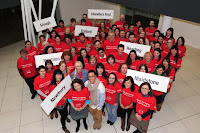
I recently won a place on Vodaphone’s World of Difference scheme. 11,000 people registered for the scheme and I was one of the lucky 500 awarded a grant to work for the charity of my choice for two months. The short essay that I entered as part of the application process was a passionate strategy that aimed to translate much of the social media training I had gained through working with Liberty842 and channel it into the charity’s own social media platforms and push forth their presence online.
My chosen charity, Carousel, facilitate people with learning disabilities to reach their potential through the arts and media. They also run the award-winning Oska Bright Film Festival, the world’s first film festival that is run by and for people with learning disabilities. The festival has already achieved international status touring Australia, Canada and Czech Republic. I was attracted to Carousels approach to the people that they work with, offering them recognition and support, rather than help. The possibilities that social networking and sharing of content present could make a considerable difference to an organization such as Carousel. I chose Carousel because I believe that sharing with them what I have learnt from Liberty842 would be a valuable experience.
On Monday 28th of February I traveled to Birmingham where all 500 winners of Vodaphone’s World of Difference scheme gathered in the Custard Factory (housed in Birmingham’s Arts and Media Quarter) to be congratulated by its directors and advocates. One of the brightest smiles that day was worn by one of Liberty842’s illustrious clients, fashion guru Gok Wan, an advocate and active promoter of the scheme. Both he and the speakers did a fantastic job of emphasizing the opportunities that all the winners had to make a difference. It felt encouraging to see a face familiar with the very company that had given me the confidence to go forward for the position at Carousel. Just like the medium it represents, Liberty842 appeared to be everywhere.
During the day the winners were lead off in groups, given phones and a crash course in tweeting and blogging about their experiences and achievements during their placements. The important role that social media would play through out the scheme was unveiled – the message was clear, World of Difference winners had the power to spread good will on a national scale, inspire others and encourage social change and mobilization.
The power of social media to drive campaigns faster and further is what seems to fill so many now with confidence and hope. If people want to make a difference they needn’t feel they have to walk alone towards change. The true magic of social media seems to be the feeling of united-ness that sits at the ends of finger tips everywhere. Communities can unite with other communities, charities with other charities, big brands with individuals to exchange messages of aspirations, achievements and criticisms on a level playing field. This was the feeling at the Custard Factory on that day, it buzzed through out the building and ignited the energy amongst Vodaphone’s new team of difference makers. The revolution is here. The revolution will be tweeted.
Connecting the dots
 On Monday 31st of January the Libery842 team attended a seminar held at the RSA. The seminar was set up to discuss new approaches to community regeneration. Attendees came from a variety of professional backgrounds to discuss how we can rebuild social networks, both on and offline. The hope is that by doing so we can reach out to the edges of society and empower the most isolated. It was quite a task to be set at 8.30 on a Monday morning, however, fueled heavily on coffee and croissants, we rolled up our sleeves and got stuck in.
Around the large tables sat a broad spectrum of experiences. Each group was given marker pens, post-it notes and A3 sheets of paper and asked to throw around ideas on developing and rebuilding relationships within a community. We rummaged through our personal toolboxes of experience and attempted to tackle this mammoth task.
Language, we all agreed is key to connecting people and since this was the case we needed to decide on easily accessible vocabulary and terminology. (It was felt that the term ‘mental heath’, for example, was far too broad and could stigmatise people – and that using more specific terms would have more relevance). It was also pointed out that language used needs to adapt to reach each community with their own set of terms and definitions.
One of the project’s aims is “to inform the policies and practices required to power and sustain the Big Society”. However it was thought that the true definition of the Big Society was not clear and therefore it was key to explore exactly what it means and how public services might be affected by any changes (as there are many isolated members of society that depend upon them). The Connected Communities initiative is trying to avoid a top-down approach to the issues they intend to tackle. As the speakers Professor David Morris and Steve Broome explained, The Connected Communities report calls for innovative solutions to local problems and local collaboration to enhance mental well-being for all. They also discussed the role of public services and if those roles can be strengthened, redefined or even reduced if better social networks are put in place.
One attendee suggested that perhaps the caring professions had a lot to “un-learn” when it came to interacting with patients. He put forward the idea that professionalism had taken over and value systems were being imposed upon communities that never really belonged to them in the first place. Public services were seen as somewhat to blame here, at times, treating the people that needed individual support more like boxes that needed to be ticked. The term “un-learning” was adopted quickly by the seminars attendees, becoming it seemed, the first addition to the group’s glossary of shared language.
Over the years, technology has fundamentally changed the way we do business – in the way we connect, communicate and build relationships. We discussed how digital solutions could be applied to help those that are most isolated within society. Although there are still many corners that the World Wide Web does not reach, it was thought that by using technology that people do have (like mobile phones, which have 130% penetration in Western Europe) would be a good place to start.
It seems as though there are still many things we must “un-learn”, many ticked boxes to reassess. However by using language that people understand, and technology that does not require new learning and is already accessible, then perhaps we could start to join those first few disconnected dots.
Talking about TV’s future


TV’s always going to be worth talking about – as we found out when we heard the findings from Thinkbox’s research into the future of telly this week.
We’ve managed the Twitter feed for Alan Carr: Chatty Man since the Channel 4 series started in 2009 so we know how much conversation a TV show can generate. However, we also know that viewer behaviour is constantly evolving so we were keen to hear about what lies ahead for TV – and that’s exactly what Thinkbox told us.
Tellyporting: Travelling to TV’s Near Future looked at how British audiences are making use of latest technology and how new services might affect – and enhance – their viewing experience.
The great news is that the research found plenty to be positive about.
For instance, the TV still seems to be the preferred device for watching full-length shows where picture and audio can be experienced at their best. It also tends to be the device that people watch with family and friends.
TV’s power to inspire conversation is as strong as it’s always been, though, of course, there are now many more places than just the water cooler for people to catch up with others about what they’re watching.
Of the 3,000 interviewees in Thinkbox’s sample, 19% had shared TV or ad content on Facebook or Twitter, 18% had chatted online and 9% had joined a Facebook group about TV or ad content.
Rather than distracting viewers from what’s happening on telly, this two-screen viewing is adding to the experience of watching a show – and in many cases is encouraging audiences to watch programmes as they air so they can see them as they happen and be part of the resulting conversation.
With 37% of the sample saying they watch the TV and go online simultaneously every day, there’s huge potential to engage these people with additional content and services without losing them along the way.
Future developments in instant-response technology through the TV can only build on this, enabling broadcasters, programme makers and advertisers to connect with audiences while listening to and learning from what they have to say.
Which technologies lead the way remains to be seen so the only thing we can be sure of at this stage is that the TV’s here to stay – and it’ll continue to be a talking point for many years to come.
We’re Golden Twits!

On Thursday 25 November, we joined the twitterati at the Golden Twit Awards. Some of @chattyman’s followers had nominated chattyman for a Golden Twit, and – once we’d retweeted the nomination – the votes came pouring in.
We certainly weren’t expecting to win anything, and we were chuffed to bits when @chattyman was handed the Live Broadcast Award by public vote.

Alan sent his congrats as did many @chattyman followers. So a big well done to Sam who mans the chattyman Twitter feed and a huge thanks to Alan, Open Mike Productions and Channel 4 for all their support and laughs over the last four series, and now into a fifth.
We believe that Sam’s dedication and humour has endeared her to the 87,400 @chattyman followers (and counting). She’ll try and answer all the questions asked, and makes sure the fans get a sneak peek of upcoming guests with gossip and photos from the green room when the show is recording. She also tweets through the breaks between series and keeps the feed alive, ready for when the new series starts up again.
It was the perfect moment to crack open a bottle of Lambrini and pass round the Twiglets in true #chattyman style.
Thanks also go to Matt Rooney for his support on this project.