
Ho ho ho – a very happy Christmas and most splendid 2014!
From everyone at Liberty842 x

Ho ho ho – a very happy Christmas and most splendid 2014!
From everyone at Liberty842 x

We’re looking for freelance Social Media Editors who are creative with a strong copywriting background and great attention to detail.
Trust and discretion is really important to us and to our clients and a clear understanding of risk management in social media spaces is essential.
Our work has a strong storytelling angle and we pride ourselves in creating content that audiences want to share and talk about.
You should be able to demonstrate experience of social media/community management.
Interested? Please send your CV to hello@liberty842.com

Stand Up For the Week returns for a fifth series on Friday and if the first episode is anything to go by, it should be a corker.
Liberty842 is managing the show’s Twitter account – @SUFTW – bringing viewers backstage content, capitalising on the feel of the live show, encouraging heckling and interaction from the viewers, as well as using it to champion live stand-up comedy.
Catch Stand Up For The Week on Channel 4 every Friday at 11.05pm – right after Alan Carr: Chatty Man!

 Another Social Media Week has come to an end in London and it’s been great to see so many people sharing their experiences of working on a huge range of projects as well as speculating about what the future holds.
Social Media Week 2013 brought with it plenty of practical insights from those in the business – as well as the threat of being included in the brilliant but rather brutal This is not an insight Tumblr.
As for Liberty842, we were privileged enough to host our own event at Gateley LLP’s magnificently positioned offices beside St Paul’s Cathedral (thankfully no mid-evening bell-ringing session to contend with this year).
Guess who? Brands, identity and reputation aimed to give those attending some practical advice on managing digital content, covering the creative process as well as the legal considerations of putting a brand out there on social media.
A strong theme of the evening was suspension of disbelief, as demonstrated by the character-driven Twitter accounts I and Liberty842 co-founder Tayler Cresswell manage for Chatty Man and Mr Selfridgeand Somethin Else’s StoryFarm publishing platform that, Trevor Klein explained, has brought to life characters from dramas Skins and Hit the Floor on social media.
These characters not only allow you to create a very distinctive tone of voice for your brand but they also offer followers a greater sense of engagement by giving them an identifiable person to communicate with as opposed to an anonymous company employee.
Taking a TV drama even further beyond the realms of its scripted storyline, James Deeley showed how viewers of Channel 4’s Utopia were invited to explore the issues raised throughout the series. The Utopia Inquiry provided many extra layers of entertainment, rewarding those with questioning minds for their efforts by taking them deeper into the story.
From TV to the biggest sporting event in the world, we got an insight into the creative challenges and opportunities of producing digital content for London 2012 as Darren Groucutt showed us the work he did for the games. Particularly interesting to note was how the works in progress – not just the finished material – captured the imagination of many and reached a huge audience when recommended by creative community online. A valuable lesson to learn here was about setting out to make great content – not to aim for viral exposure in the first instance.
Creativity and experimentation are always to be encouraged but there’s a definite need to have the legal essential covered before putting content out online. Thankfully Gateley LLP’s Lisa Logan was on hand to give an overview of brand protection for social media and how to be transparent about advertising and sponsorship through your accounts. Being upfront about paid-for posts is always advisable to ensure you’re not breaching CAP code guidelines.
Lisa also touched on the new Defamation Act and how all of us should be aware of its implications, whether in a professional or personal capacity.
Thanks to everyone who came along on the night – especially to our speakers Lisa Logan, Trevor Klein, Darren Groucutt and James Deeley.
Look forward to seeing you again at Social Media Week 2014 but if there’s anything Liberty842 can help you with before then just drop us a line.
Liberty842 returns to Social Media Week for the third time with a session called Guess who? – all about brands, identity and reputation.
It may seem hard to imagine a time before Facebook, Twitter, Instagram and Pinterest to name a few platforms, but we’re still at a relatively early stage in the social media game and the rules remain a work in progress.
Thanks in no small part to some notable slip-ups from individuals and brands, the sometimes unruly world of social media is getting to grips with much clearer guidelines on what is and isn’t permissible for organisations as opposed to individuals. Those rules are relatively recent additions so we’ve asked Gateley LLP Partner Lisa Logan to explain the latest developments, including the all important new Defamation Act as well as the CAP code.
Legal matters aside, there is no single set of instructions about what your content should be and how you should manage it – which makes it all the more exciting to try new things out.
Two people with no shortage of experience in that department are Darren Groucutt – Creative Director at Relative, award-winning animation director and man behind the digital content for London 2012 – and James Deeley – Creative Director and strategist at Amaze who has previously worked on Harry Potter website Pottermore and multiplatform project The Utopia Inquiry for Channel 4.
Darren and James will show you the possibilities for engaging your audience using content, giving a taste of the creative opportunities for getting followers genuinely involved in a one-off campaign or for the long term.
Demonstrating how fictional characters from TV drama can step outside the boundaries of a show and draw the audience in further, Somethin’ Else Head of Development for digital projects Trevor Klein will talk about the work he’s done with broadcasters on projects including Skins, Emmerdale and new US drama Hit the Floor.
Taking another angle on the characters theme, Liberty842 Co-founder and Editorial Director Tayler Cresswell will talk about identity on social media, using case studies such as Alan Carr Chatty Man and Mr Selfridge to explore how a distinctive tone of voice can have a powerful effect in strengthening the relationship between a brand and its audience.
With some help from me, Writer and Content Producer, Tayler will also look at some of the ways you can protect your brand in the event of negative feedback or if another social media user is damaging your brand’s reputation by assuming its identity.
Go to the Guess Who? event page on the Social Media Week website to book tickets (if the event is listed as fully booked then simply use our contact form to join the waiting list in case of any cancellations). Follow Liberty842 on Twitter for updates from Social Media Week and on the industry in general.
We look forward to meeting you on Monday 23 September at 6.30pm.

The good old British boozer has a centuries-long history as a community venue but its future looks far from certain.
I know this from personal experience as my local – The Ivy House in Nunhead, southeast London – closed down in April 2012 when the company that owned it sold it off and rumours began to circulate that it was doomed to redevelopment.
Fortunately for The Ivy House, a team of highly-skilled neighbours formed a steering group and used their specialist knowledge, contacts and a whole lot of their time to put together a plan to first save the building and then bring it back into use as a pub for the community. You can read more about that on the Ivy House website and on The Guardian’s Co-operatives and mutuals hub.
I should make it clear at this point that I’m not on the Ivy House steering group so I consider my involvement in the project to be just a small part of the combined effort that a large number of local people put in to help save a venue they love and protect it for the years ahead.
 Led by the Ivy House Facebook group and Twitter account, the community has really got behind the campaign and spread the word far and wide, getting national and international exposure for the project to an extent that would be hard to imagine as little as a decade ago.
While the interest from further afield is undoubtedly welcome, I’d argue that local awareness has played the greater role in the success of the Ivy House campaign to date – and it’s also given me some valuable insights for this sort of campaign.
Forums and email newsletters are far from dead
Facebook and Twitter may be the platforms most often referred to when the term social media is used, but don’t underestimate the part that older technologies play.
Forums and message boards remain very important in local communications. Southeast London has the East Dulwich Forum and South East Central – two well-used sites that are often the first place residents will go to for latest news and recommendations for local businesses.
Similarly, email newsletters have played a vital role for the Ivy House campaign. Though newsletters can sometimes feel too much like junk mail – even those customised to user prefences – when you’re dealing with a relatively small group of recipients they can be very effective at ensuring all latest updates reach the people concerned in the right way.
Traditional media still has a vital role to play
Social media was critical for increasing awareness of the Ivy House campaign and no doubt led to the majority of the approaches from traditional media to cover the story. That said, print and broadcast media are still hugely powerful in getting a story to a wide audience – including a significant number who aren’t social media users.
The Ivy House has featured on everything from southeast London radio station Resonance FM and local newspaper Southwark News to regional TV bulletin BBC London News and now its story reaches a national audience on The One Show.
Online communication is only part of the story
Local campaigns can be and have been fought and won using social media but that’s certainly no substitute for meeting people from your community face to-face. Had a large number of Ivy House regulars not turned up in the pub on hearing the news of its closure then I very much doubt we’d be in the position we’re in today with the venue about to reopen as London’s first co-operative pub.
Getting to know my neighbours initially seemed like a great additional benefit of this experience but on reflection I suspect this was actually fundamental for everyone involved. Once those relationships were formed, social media kept the momentum going and ensured the campaign remained fresh in our minds, while also spreading news of latest developments to those who could offer further support.
Following a community share offer that exceeded the original target of £100,000, The Ivy House has now been given some long-overdue TLC and is well on its way to reopening. While there are plenty of challenges ahead, the pub returns to use in much better shape than it has been for years. As for its customers and the local community, they haven’t been so united behind a cause for a very long time.
Cheers to that!
 Channel 4’s Dispatches programme last night focused on social media, celebrity endorsement the problem of ‘click farms’, which promise to generate thousands of fake fans for a fee.
Dispatches’ Celebs, Brands and Fake Fans will inevitably lead to questions about the veracity of social media posts, of the integrity of celebrities and brands on Twitter, Facebook and YouTube, and of the value of social media data and insights.
The programme focuses on “click farms” – which, for a fee, are fraudulently used to boost follower and Like numbers on Twitter and Facebook and views on YouTube for example. It also looked into the thorny issue of paid celebrity endorsements for products and brands.
However, what was not made clear in the programme was how widespread this practice might be. They highlighted some questionable practices, but I’d argue that, sadly, there are cowboys in every industry, and people out there who fall for their spiel without getting proper advice.
The social media industry has grown up considerably over the past 3-4 years for two main reasons:
The reaction on Twitter was interesting with many wondering what all the fuss was about – surely this happens in every industry? – and others were shocked at the revelations. My worry is that many will tar everyone working in social media with the same brush.
And to be honest, I was most sorry for the poor sods in Bangladesh earning a pittance by spending hours in windowless rooms creating fake likes and follows.
Here’s some best practice advice…
ADVERTISING AND SPONSORSHIP
There have been plenty of high profile cases of paid sponsorship deals that have fallen foul of advertising codes, but many cases seem to be down to ignorance rather than any deliberate attempt to mislead. It’s always best to be open and honest – if you’re getting paid to advertise something simply add the hashtag #ad or #spon to your tweet.
The Internet Advertising Bureau has some useful guidance on the use of social media and paid promotion their website. It should be mandatory reading for agencies, celebrities, brands… If you’re not sure about something, get advice before you post.
There’s a real grey area around freebies and tweeting about them, and I’m not sure that the Coronation Street actors or Russell Kane, both mentioned in the programme, broke any rules. They all denied being paid for tweets.
Conversely, we have found that the practice also leads to false accusations of advertising when celebrities talk about brands in passing.
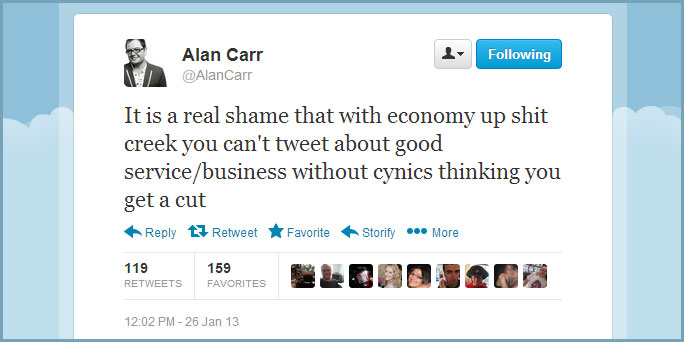
It is a real shame that with economy up shit creek you can’t tweet about good service/business without cynics thinking you get a cut
— Alan Carr (@AlanCarr) January 26, 2013
Really weird, slightly depressing and tedious that I get so many tweets accusing me of being paid to tweet about something. I don’t.
— Jonathan Ross (@wossy) January 26, 2013
In short: be up front about what the deal is. People don’t mind advertising if they know what it is – and if it isn’t the sole purpose of an account!
A NUMBERS GAME?
When it comes to fake fans, we think that there is a huge problem with buying Facebook Likes, Twitter follows or YouTube views and subscribers. Whilst the numbers might look impressive, they have little worth bar fooling some into thinking that you’re a “big player”. There’s more to be said for slowly building a following of genuine fans.
Social media data can be valuable – you can get instant feedback from fans, viewers, listeners. You can see what kind of people are attracted to your programme or brand.
As David Ellis from analytics agency Station 10 told me, “There’s a risk of accepting data from social media sites at face value. The vital point is to establish links to actual sales or legitimate behaviour from social media, and fortunately most brands will have other data sources against which to validate social performance.”
When it comes to interrogating data, he offered the following pointers:
THE LONG GAME
There are no real quick wins when it comes to social media. We advise our clients to see the long game . Engagement is all important, and you can’t have any kind of meaningful relationship with a fake “fan”.

 “You should come with me” were the words of David Downton, fashion illustrator extraordinaire, when the proposal for him to join Instagram during couture week in Paris was suggested. If you’re still scratching your head, you’ll have seen his illustrations on the pages of Vanity Fair and Vogue and on bags at M&S. David is also Artist in Residence at Claridge’s Hotel. I would argue that is perhaps the best job in the world.
It’s one of those proposals that seemed so far-fetched that it could never really happen but, before I knew it, I was on the Eurostar to Paris, crashing into the world of couture (quite literally, I had not one invitation to my name) at the same speed as the train that got me there.
The world of couture could easily be seen as old-fashioned and outdated, with an inability to move forward. Yet, there was an air of newness at this year’s Autumn/Winter presentations. The first heel to hit the catwalk couldn’t have screamed “I’m back!” any louder than that of Naomi Campbell, marking her return to the Versace runway after a 15 year break (I should note, that’s almost as long as I’ve been on the planet).

A narrative of new continued with Christian Lacroix’s homage to Elsa Schiaparelli, marking the highly anticipated re-launch of her eponymous couture house. Then there was Karl Lagerfeld’s view to a new world, observed as the backdrop of a destroyed theatre at Chanel. As the biggest running couture house, Lagerfeld’s vision appeared to recognise the need to constantly move forward – to remain ‘new’ in a craft that easily can fall into being outdated.
Apart from the clothes, the experience was also very new to me. It was a world that I had always immersed myself into fully through external means, but somewhere I had never entered in reality. But it wasn’t all about me. I was there to start David Downton’s Instagram account (coincidentally, another new beginning).
The world of fashion and Instagram have such a strong relationship due to the complete reliance on imagery over words and you only need to look at Burberry (arguably the front runner in terms of a fashion house using social media) and their 874,000 followers to get a feel for the huge amounts of traction that Instagram can create. This power is only reinforced by the response to their images, with an image of their Regent Street store gaining almost 30,000 likes and another of it-girl Cara Delevingne soaring to over 45,000 likes. They’re not alone, however. From Selfridges to Topshop and Versace to couturier Elie Saab, Instagram encompasses the whole spectrum of the fashion industry. Thus, David’s work makes for a perfect fit into an already thriving world of fashion social media, filling a gap that joins his skilled craft with a fast-paced medium.
Pairing together David’s visual language and the importance of images on Instagram made for an exciting partnership; yet, it became apparent that Instagram has become a fickle game of likes where, regardless of the image, there are users who will like David’s images unconditionally. It then leads to question, does Instagram become a social network where it is not about what you like but who you like?
Analysis aside, it was great to see the reaction to David’s images on Instagram. Although some of the best reactions (in terms of likes gained) came from a video of David sketching at the Elie Saab show or his illustration of the Christian Lacroix for Elsa Schiaparelli presentation (see above), it was encouraging to see a more emotional connection through a picture of some scrunched-up drawings – titled ‘Bad day’ – with one follower admitting it was “encouraging to know that even you have bad days”.
In many ways, David’s account allows his followers to see into his life outside of his work, something that is rarely seen. One thing that does become clear after peeking into David’s world is the way in which there is a seamless movement from the charm of his work to the charm of the man himself.
Considering this is only a snapshot into the world of David Downton – a mere season in his 17-year run of couture shows (and that’s 2 seasons per year) – there’s certainly more to see, albeit past or present.
 David Downton adds: “Never an early adopter, I finally embraced Instagram thanks to Liberty842, who provided the perfect help mate in the form of Connor Beesely. Mr Beeseley’s tact, quiet humour and pin point thinking can’t be over praised. How long before I’m asking him for a reference?”
Follow David Downton on Instagram
Find out more about David and his work on DavidDownton.com
Post written by Connor Beesley, Editor at Liberty842

Online, conversation, debate and comment about The Archers reaches a peak on Sunday mornings when many join the regular tweetalong as the show’s omnibus is aired.
Listeners share their thoughts and feelings – good, bad and indifferent – about the characters and storylines on Twitter and offer an amusing, often irreverent, take on events in the fictional village of Ambridge where the show is set.
I spotted this tweet yesterday from a new listener to BBC Radio 4’s The Archers. If you’ve noticed #TheArchers trending on Twitter most Sunday mornings, you might not be too surprised.
“@nick_hubert: I didn’t think anyone listened to The Archers until I joined Twitter.” I’ve started listening again BECAUSE of Twitter. — Jane Duke (@stoneflowerjane) July 21, 2013
The tweetalong, as it’s affectionately called, started in 2009-10 when two listeners, @JaneSoup and @LucyLyons, would tweet their amusing and sometimes sweary commentary to the omnibus. They picked up a following and it certainly got people talking. Today it centres around the hashtag #thearchers, and tweetalongers follow tweets about the programme and join the conversation with fellow listeners. They demonstrate a pretty sophisticated use of Twitter, with many using tools like Tweetdeck to exclude the hashtag to avoid spoilers until they’re ready to listen and chat.
Of course, the official account for the show, @BBCTheArchers, joins the regular tweetalong around broadcasts, answering queries and adding an extra layer to the listening experience. But it’s the listeners who really make the difference, not only giving valuable and timely feedback about the programme, but enticing others to join in the fun and become regular Archers listeners.

Read more listener discussions on The Archers blog
Find out about the world’s longest running soap opera, The Archers

I suspect we were the only social media practice to attend the Broadcast Commissioning and Funding Forum on Tuesday at BAFTA – which was surprising given the amount of time given over to the digital environment and its effect on traditional “linear” TV.
There was an impressive speaker line up from the big broadcasters: the top Televison boys at the Beeb (Danny Cohen), ITV (Peter Fincham), Sky (Stuart Murphy) and C5 (Ben Frow) – Murphy and Frow in particular gave highly entertaining accounts of what they do at their respective broadcasters.
C5’s Ben Frow hilarious. When asked which commissioner to approach he says “draw straws.. If it’s got sequins in it, talk to Greg” #cfforum
— LIBERTY842 Ltd (@Liberty842) July 2, 2013
Interesting to hear Danny Cohen say that “we’re fighting for screen time rather than TV audience time” in a nod to the multiplatform world.
And All3Media‘s Gary Woolf said that they are having to think about apps earlier and earlier in the development cycle. It may have been the calibre of the speakers, but we came away with the feeling that broadcasters and producers are trying to move towards a more integrated approach to multiplatform content. Less of a ‘bolt-on’ mentality – *hopeful face*.
Rachel Ball from YouTube gave a highly informative speech about how YouTube is working to encourage more content owners to use their platform “to make money” (through Content ID tagging and advertising). However, the big take out was that it’s unlikely that YouTube will continue to fund channels after the last round of funding which was aimed at proving YouTube “was a place for sustainable businesses” rather than a long term strategy.
Ball said that YouTube offers production companies “a chance to work in a retail environment… business to consumer”. Using Content ID, companies can track their own content and if others appropriate it, they can either block it, or collect data and ad revenue against it.
She spoke of the core YouTube audience as “Generation C… curation, creation, community and connection” and went on to say that “80% of millenials are members of Generation C”.
For production companies, Ball said that clips had found new life on YouTube and were particularly successful for chat shows, citing Ellen in the US as an example. Ellen’s YouTube channel has 5.9m subscribers and has been highly successful in using clips from the TV show to engage with audiences online.
Giving an on-the-ground account of creating content for YouTube was a panel of speakers: Zoe Collins from Fresh One (they’re behind Jamie Oliver’s FoodTube channel); Darren Devitt from the awesomely successful Machinima; Selma Turajlic from Little Dot Studios and Derren Lawford from youth engagement agency, Livity.
In creating content for YouTube, they agreed that the process was unlike traditional broadcasting. Collins said it was a “swift process” that had to strip back “fluffiness”. There’s no time for fancy title sequences or recaps – your audience is easily distracted by other content. It was, she said, “the audience’s channel” – they’re going to tell you very quickly what they think and “you need to tell them that you’re responding”.
On audience feedback, Machinima’s Darren Devitt said that they particularly monitor what’s said in the first two days of the video going up, and then again on day 24.
Whilst most said that YouTube wasn’t yet providing a real return on investment through advertising on the channel, sponsorship deals and product tie-ins seem to be filling the gap.
An interesting aside was discovering how many of the YouTube talent – “bedroom producers” – already have agents.
There was also a panel discussion about defining new audience relationships. They talked about the “rise of participation TV” and the all-important data that’s available at a fairly granular level from online platforms.
Zeebox’s Anthony Rose said that today’s “bunch of smart tech kids thinking up stuff around someone else’s show” was something that wouldn’t last. Ashley Mackenzie from rights management company Base 79 added that YouTube is a “performance based industry” as opposed to Television which was “brand-based”.
They spoke about marketing being “clip by clip” and Rose spoke about the power of ads synced to the second screen in line with what was being shown on broadcast TV.
There were some nice examples of better brand engagement, notably Ogilvy’s Ford tie-in for The Endless Winter and Chanel 4/Sainbury’s What’s Cooking.
All in all a really interesting day – though we would have liked to see more women speakers at these kind of events. Three out of 17 isn’t good enough.