A brand new digital presence for Shirley Conran

Best-selling author and journalist, Shirley Conran OBE, has a brand new website.

A joint development between Liberty842 and Do Tank Studios, shirleyconran.com showcases Shirley’s novels, her writing and gives her a platform for her often controversial views on everything from sex and power to packing for a holiday on her blog.

The new website has been developed to coincide with the launch of her new maths ebook, Money Stuff, which aims to help women manage their money better – and get richer!

Shirley Conran is also tweeting her views @ShirleyConran.


Shirley Conran’s innovative maths ebook launch

Tayler Cresswell of Liberty842 - The social media company

“Life’s too short to be short of money.”

Shirley Conran’s innovative ebook, Money Stuff, launches today.

Money Stuff is a 4-step do-it-yourself maths course – designed for the iPad – for women that is relevant to real life.

Those doing the course – or thinking about it – can ask questions and get support online through Money Stuff on Facebook and Twitter – managed by Liberty842

Shirley Conran says: “We need to tell our daughters they can’t just sit through maths lessons until they’ve finished studying and then forget about it. The first day they leave school is the first day they’ll need maths.”

Interested? You can try the first book for FREE!

Money Stuff for the iPad

The trouble with social media – Dispatches’ Celebs, Brands and Fake Fans

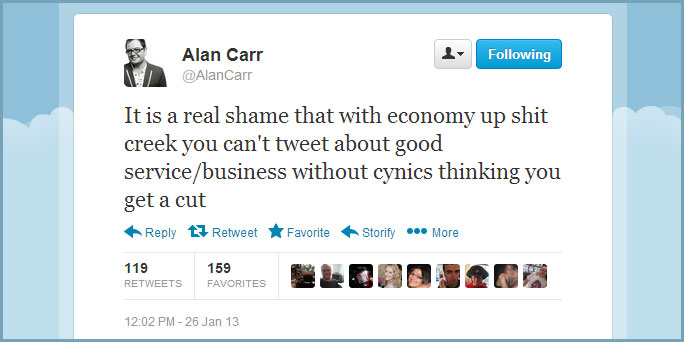
Alan Carr tweet about Dispatches - @AlanCarr

Tayler CresswellChannel 4’s Dispatches programme last night focused on social media, celebrity endorsement the problem of ‘click farms’, which promise to generate thousands of fake fans for a fee. 

Dispatches’ Celebs, Brands and Fake Fans will inevitably lead to questions about the veracity of social media posts, of the integrity of celebrities and brands on Twitter, Facebook and YouTube, and of the value of social media data and insights.

The programme focuses on “click farms” – which, for a fee, are fraudulently used to boost follower and Like numbers on Twitter and Facebook and views on YouTube for example. It also looked into the thorny issue of paid celebrity endorsements for products and brands.

However, what was not made clear in the programme was how widespread this practice might be. They highlighted some questionable practices, but I’d argue that, sadly, there are cowboys in every industry, and people out there who fall for their spiel without getting proper advice.

The social media industry has grown up considerably over the past 3-4 years for two main reasons:

  • Data and insights coming from genuine fans and customers through social media, the instant feedback on a programme or product, can be incredibly valuable. Add thousands of fake fans to your Facebook page or Twitter following and you render your data worthless.
  • Paid for tweets can create an unwelcome backlash – many fans will object to being advertised to on social media platforms unless it’s done sensitively and openly.


The reaction on Twitter was interesting with many wondering what all the fuss was about – surely this happens in every industry? – and others were shocked at the revelations. My worry is that many will tar everyone working in social media with the same brush.

And to be honest, I was most sorry for the poor sods in Bangladesh earning a pittance by spending hours in windowless rooms creating fake likes and follows.

Here’s some best practice advice…

ADVERTISING AND SPONSORSHIP 

There have been plenty of high profile cases of paid sponsorship deals that have fallen foul of advertising codes, but many cases seem to be down to ignorance rather than any deliberate attempt to mislead. It’s always best to be open and honest – if you’re getting paid to advertise something simply add the hashtag #ad or #spon to your tweet.

The Internet Advertising Bureau has some useful guidance on the use of social media and paid promotion their website. It should be mandatory reading for agencies, celebrities, brands… If you’re not sure about something, get advice before you post.

There’s a real grey area around freebies and tweeting about them, and I’m not sure that the Coronation Street actors or Russell Kane, both mentioned in the programme, broke any rules. They all denied being paid for tweets.

Conversely, we have found that the practice also leads to false accusations of advertising when celebrities talk about brands in passing.


In short: be up front about what the deal is. People don’t mind advertising if they know what it is – and if it isn’t the sole purpose of an account!

A NUMBERS GAME?

When it comes to fake fans, we think that there is a huge problem with buying Facebook Likes, Twitter follows or YouTube views and subscribers. Whilst the numbers might look impressive, they have little worth bar fooling some into thinking that you’re a “big player”. There’s more to be said for slowly building a following of genuine fans.

Social media data can be valuable – you can get instant feedback from fans, viewers, listeners. You can see what kind of people are attracted to your programme or brand.

As David Ellis from analytics agency Station 10 told me, “There’s a risk of accepting data from social media sites at face value. The vital point is to establish links to actual sales or legitimate behaviour from social media, and fortunately most brands will have other data sources against which to validate social performance.”

When it comes to interrogating data, he offered the following pointers:

  • Look out for increased volumes in social activity over short periods against a benchmark, particularly from otherwise obscure international markets.
  •  Create a segment or view to focus on traffic that comes from your core or home markets.
  •  Match these patterns against web site traffic, to see if this correlates.


THE LONG GAME

There are no real quick wins when it comes to social media. We advise our clients to see the long game . Engagement is all important, and you can’t have any kind of meaningful relationship with a fake “fan”.

Instagram-ing (or InstaGlam-ing) my way into the world of Couture

David Downton's Instagram account

Connor Beesley“You should come with me” were the words of David Downton, fashion illustrator extraordinaire, when the proposal for him to join Instagram during couture week in Paris was suggested. If you’re still scratching your head, you’ll have seen his illustrations on the pages of Vanity Fair and Vogue and on bags at M&S. David is also Artist in Residence at Claridge’s Hotel. I would argue that is perhaps the best job in the world.

It’s one of those proposals that seemed so far-fetched that it could never really happen but, before I knew it, I was on the Eurostar to Paris, crashing into the world of couture (quite literally, I had not one invitation to my name) at the same speed as the train that got me there.

The world of couture could easily be seen as old-fashioned and outdated, with an inability to move forward. Yet, there was an air of newness at this year’s Autumn/Winter presentations. The first heel to hit the catwalk couldn’t have screamed “I’m back!” any louder than that of Naomi Campbell, marking her return to the Versace runway after a 15 year break (I should note, that’s almost as long as I’ve been on the planet).

A narrative of new continued with Christian Lacroix’s homage to Elsa Schiaparelli, marking the highly anticipated re-launch of her eponymous couture house. Then there was Karl Lagerfeld’s view to a new world, observed as the backdrop of a destroyed theatre at Chanel. As the biggest running couture house, Lagerfeld’s vision appeared to recognise the need to constantly move forward – to remain ‘new’ in a craft that easily can fall into being outdated.

Apart from the clothes, the experience was also very new to me. It was a world that I had always immersed myself into fully through external means, but somewhere I had never entered in reality. But it wasn’t all about me. I was there to start David Downton’s Instagram account (coincidentally, another new beginning).

The world of fashion and Instagram have such a strong relationship due to the complete reliance on imagery over words and you only need to look at Burberry (arguably the front runner in terms of a fashion house using social media) and their 874,000 followers to get a feel for the huge amounts of traction that Instagram can create. This power is only reinforced by the response to their images, with an image of their Regent Street store gaining almost 30,000 likes and another of it-girl Cara Delevingne soaring to over 45,000 likes. They’re not alone, however. From Selfridges to Topshop and Versace to couturier Elie Saab, Instagram encompasses the whole spectrum of the fashion industry. Thus, David’s work makes for a perfect fit into an already thriving world of fashion social media, filling a gap that joins his skilled craft with a fast-paced medium.

Pairing together David’s visual language and the importance of images on Instagram made for an exciting partnership; yet, it became apparent that Instagram has become a fickle game of likes where, regardless of the image, there are users who will like David’s images unconditionally. It then leads to question, does Instagram become a social network where it is not about what you like but who you like?

Analysis aside, it was great to see the reaction to David’s images on Instagram. Although some of the best reactions (in terms of likes gained) came from a video of David sketching at the Elie Saab show or his illustration of the Christian Lacroix for Elsa Schiaparelli presentation (see above), it was encouraging to see a more emotional connection through a picture of some scrunched-up drawings – titled ‘Bad day’ – with one follower admitting it was “encouraging to know that even you have bad days”.

In many ways, David’s account allows his followers to see into his life outside of his work, something that is rarely seen. One thing that does become clear after peeking into David’s world is the way in which there is a seamless movement from the charm of his work to the charm of the man himself.

Considering this is only a snapshot into the world of David Downton – a mere season in his 17-year run of couture shows (and that’s 2 seasons per year) – there’s certainly more to see, albeit past or present.

David Downton, artist and fashion illustratorDavid Downton adds: “Never an early adopter, I finally embraced Instagram thanks to Liberty842, who provided the perfect help mate in the form of Connor Beesely. Mr Beeseley’s tact, quiet humour and pin point thinking can’t be over praised. How long before I’m asking him for a reference?”

Follow David Downton on Instagram
Find out more about David and his work on DavidDownton.com

Post written by Connor Beesley, Editor at Liberty842

Twitter gold for Paralympic athletes

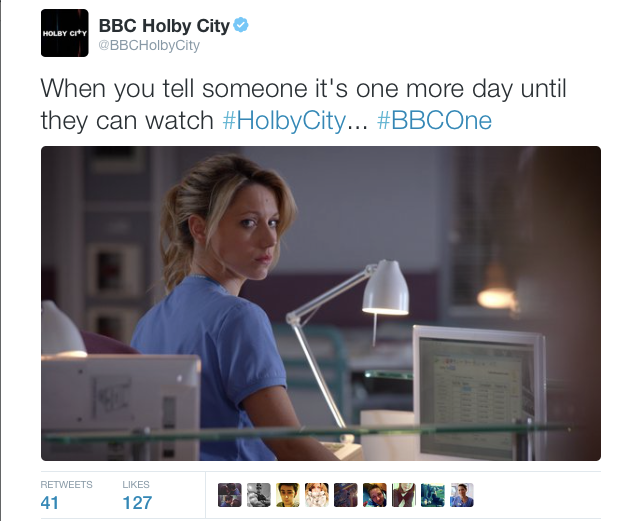
BBC Holby City tweet

It’s over a week into the Paralympic games and it’s drumming up some impressive stats.     Team GB are second to China in the medal table, with 32 gold medals in total, including ten for Athletics alone. You may be familiar with a few of them – Eleanor Simmonds, David Weir, Liz Johnson and Jonnie Peacock are the names currently causing a buzz around the Olympic village. Dive a little deeper into social media and these same athletes are competing for their online presence – and increasingly seeing the benefits.

Paralympic athletes are fast becoming household names and seeing their profiles soar as their successes in the medals table continue to boom. A great measure of this success can be seen on social media. Triple medal winner Ellie Simmonds has seen a boost of 376% in followers on Twitter (up to over 21,000) and 403% on Facebook, to over 18,400 fans since the start of the event. Sarah Storey, also a double gold medallist, set the Velodrome alight this week and has also experienced significant gains online, with a rise of almost 100% in Twitter followers and a whopping 479% increase on Facebook. With more medals up for grabs, her profile is surely set to continue to increase as the week goes on.

The International Paralympic Committee’s social media guidelines for London 2012 actively encourage tweeting and Facebook posts, making it the first truly social Games. Indeed Craig Spence, IPC Media & Communications Senior Manager, said: “The IPC wants to use the power of social media to spread the Paralympic vision and share the Paralympic experience so that anyone anywhere in the world can be part of these Games.” Furthermore, rules for posts include:

  • These must be in the first person, their own personal opinion or views and related to their own personal Paralympic-related experience.
  • They should not contain any interview with, or stories about, other Accredited Persons
  • Postings should be polite, courteous, and respectful in their messages to others and shall not use obscene, profane, vulgar, sexually explicit, defamatory, or abusive language.


Straightforward and self-explanatory maybe but putting these rules in place ensures a level of respect from athletes and the IPC’s proactive dedication to maintain this positive rapport. Perhaps something Twitter itself can learn, its terms and of service essentially stating ‘You are what you Tweet – and we’re not responsible for it’. An active approach to curb negative posts and so-called ‘internet trolls’, through guidelines alone, by the hand that feeds may help to generate a more positive ethos.

Paralympic volunteers are also getting involved in the social media Games, helping to regulate athlete’s tweets from within the media village. I spoke to one helper who details her experience:

“I was assigned to monitor a screen in the Olympic village canteen which ran a live Twitter feed. If athletes posted messages with certain hashtags, for example #proudparalympian, these would come through for me to filter onto the screen. They were encouraged to use this tag, along with any to do with Paralympics London 2012.

“My job was to approve these tweets, allowing them to appear on the screen. I was verbally told what I had to look out for, for example, do not approve tweets if they’re offensive. Some were ambiguous. For example, if a team had lost, I couldn’t tell if the way a reaction was written was classed as ‘offensive’. You can’t always get the tone if it’s just written down. If I was unsure I just didn’t approve it. I also deleted ones that tweeted to loads of people, or contained just a link. A few were also in different languages, so I had to Google translate them prior to approval.

“The most frequent tweets gave thanks to everyone for their support, notified what time their race was starting or stated happiness over a win. Athletes would tweet about winning and losing games but even when they lost they wouldn’t show any bitterness or too much sadness. They would have a positive tone, like ‘chin up’ or ‘we will be back’. I obviously wanted to capture tweets from well-known athletes.

“I think tweets from fans encourage athletes a lot and make a big difference, as I saw so many messages of appreciation coming through. Compared to four years ago in Beijing, social media has made a massive contribution and played quite a big part in the games.”

For tips on the top athletes to follow, see IPC’s social media manager Natalia Dannenberg’s Top 50 Tips on who to Follow at the London 2012 Paralympics.

@Paralympic – Official Twitter page of the International Paralympic Committee (IPC), the global governing body of the Paralympic Movement.

http://www.paralympic.org/

By Emma Rink


Twitter: a positive social media tool for Olympic athletes and fans

Whether they ran, swam or pole vaulted their way through the Olympics, there was one event that every athlete could take part in: tweeting. Forget the journeys thousands of fans made to the games each day – in the end, it was Twitter that brought in the most traffic.

The ‘social media olympics’, as it is now widely known, allowed viewers to access Olympic coverage from the bathroom to the office at the click of a button. A fantastic feat by the BBC, no doubt, as head of coverage Roger Mosey wasn’t shy to point out via his personal Twitter account.

The athletes succeeded in getting on our televisions but with the rise of social media we were equally successful in getting inside their heads and (moreover) whenever either party felt like it. No longer did we have to wait for the breathless post interview by the reporter. Now, we could cut out the middle microphone and instantly access these thoughts ourselves.

Twitter’s unique selling point is its ability for users to connect directly, in ways previously not thought possible. Michael Phelps exchanged tweets with President Barack Obama for example, who tweeted, “Congrats to Michael Phelps for breaking the all-time Olympic medal record. You’ve made your country proud. – bo” Phelps replied, “Thank you Mr. President!! It’s an honor representing the USA.” The ability for fans and athletes to connect in this way gave the games a human, personal touch that encouraged a sincere devotion and will to those competing and a true appreciation for their spectators. Social media became universally social.

And with statistics comes truth: When the U.S. Women’s Gymnastics team won a gold medal, there was a spike of 29,000 tweets per minute, Twitter said. And when U.S. swimmer Michael Phelps achieved a record number of Olympic medals, it prompted some 37,000 tweets per minute. Usain Bolt’s successful defense of his 200m title, his second gold following his 100m victory at the London Olympics, led to so much discussion on Twitter that it set a new record during the Games, with a heady 80,000 tweets per minute flurry during his win. In total, over 15 million fans followed the Olympics on Twitter; with tweet volume 100 times more than that of the Beijing Olympics back in 2008.

Another positive by-product from the ‘Twitter Olympics’ is its generation of thousands of tweets and countless conversations about sport. The NBC Olympics Twitter Tracker counted 383,174 tweets about swimming and 335,881 tweets about gymnastics during the first week of the games, for example.

Athletes have also used Twitter to encourage followers to practise sports and promote their own training regimes. And as the government takes notice and makes a pledge to introduce compulsory competitive sport to the National Curriculum, one must argue the online and offline conversation generated from the Olympics has contributed to this move forward.

The negative side to the Twitter Olympics is well-documented; UK diver Tom Daley received malicious tweets telling him he’d let his late father down, which led to the tweeter’s arrest. Greek triple jumper Voula Papachristou was banned from the Olympic team after tweeting racist comments about African immigrants in Greece. And Australian swimmer Emily Seebohm blamed social media for her failure to take gold in the 100m backstroke.

Twitter has proven just as important for the Olympics as the coverage itself. With the Paralympic Games under way, related online conversation is eagerly anticipated and is sure to expand in diverse and interesting ways. But while there are the obvious pitfalls, we cannot ignore the positives: for athletes and fans, social media and most importantly, sport itself.

By Emma Rink

Teen fans use twitter to mobilise online – and offline

“Then I saw his face… now I’m a Belieber”. If The Sun’s news story, telling how 300 girls broke into ITV London’s studios to meet their idol Justin Bieber, is anything to go by then it really is that easy.

The teen throb was recording Alan Carr’s Summertime Specstacular when the diehard fans stormed past security barriers – plus our very own Daisy and Tayler.

“We suddenly saw loads of girls screaming and running up the driveway at the back of ITV studios! It was scary!” reports a bewildered Tayler. Luckily, managers closed the main studio doors before true Fandemonium – and indeed Alan’s glasses – broke loose.

If you’re questioning how a lustful group of tweenagers synchronized such an orchestrated affair, social media may provide an answer. One fan’s comment on the article reveals all:

“Us fan girls revolve our lives around Justin Drew Bieber, we may have school but everything…..EVERYTHING is about him. We have twitters dedicated to him where we spend hours tweeting him to follow us. We have tumblrs. .. thinking about someone for years then finally getting the chance to meet them is crazy! There’s nothing to describe it it’s like the best feeling in the world.”

We are doing a lot of research around fan networks at the moment – how and why followers communicate with each other over their hero and the real life outcomes of these online (and sometimes quite finely tuned) operations.

Using Twitter and Tumblr as a tool to connect with your idol can effectively bring fans together from all corners of the globe to create an unstoppable army of devotees, narrowly missed by Liberty842 during their firsthand experience of the extreme end of Beiber Fever. With Twitter pages now dedicated to meeting your icon, it surely won’t be long before a new horde of Beliebers are out in force.

One Direction fan tweet

Twitter also allowed us to speak directly to One Direction fans planning to come down to the Alan Carr show for the band’s first ever chat show interview. Many have stayed Chatty Man fans ever since, proving Twitter as an invaluable tool to gain and maintain new audiences.

We spotted on Twitter a more primal example of a One Direction fan’s desperate attempt to spot the teen heart throbs outside the ITV studios (note: caps and swear words mean business):

“ANYONE THAT IS AT ALAN CARR TODAY AND HAS A BLACK BERRY, I BEG OF YOU. FUCKING TAKE A PICTURE AND TWEET IT. merci.”

A nice story I came across told how almost 4,000 people used Facebook, Youtube and Twitter help a young girl suffering from cancer to meet her idol, Taylor Swift.

After Lexi Barnett was denied by record executives at a US concert to meet Taylor, a Penn State University student-run philanthropy organization – known as THON – took matters into their own hands via social media, to eventually catch the attention of a fellow student who had “meet-and-greet” passes for her next show.

Birds of a feather really do flock together – all it takes is a tweet.

By Emma Rink @emmarink


Alan Carr – the UK’s #2 most influential Tweeter

Sam got a bit of a shock yesterday morning when she woke to find she was in The Independent. Alan Carr has been voted the UK’s #2 most influential tweeter, jointly with Sarah Brown and second only to Sir Richard Branson.

Alan’s Twitter success is partly attributed to the fact that promotion of Alan’s TV show Chatty Man is ‘siphoned off to a separate Twitter account operated by a girl called Sam who “works from a cell”, according to Carr. This frees up the man himself to fill his timeline with… a Twitter output that is engaging, upbeat, funny and occasionally a bit crazy.’

@Alan Carr boasts an impressive PeerIndex of 92, Authority score of 95 and well over 2 million followers.

We always knew Alan was a natural at Twitter – the account was originally set up back in 2008 as a simple way for Alan to update his website on the move by text. His affinity with the medium has brought its own rewards. Alan’s talked about it being a great way to talk directly with his fans, and he’s also thanked his Twitter fans – from both @chattyman as well as @AlanCarr – for helping him win the National TV Award for Best Talk Show.

Here he is talking to Sam about Twitter last month – and below that, Alan spills the beans about who Sam really is…

If you’re interested in finding out more about how social media can work for you, get in touch.